
A planner sits down with ChatGPT and asks for help finding suitable parcels for a new fire station. They paste in a description of the criteria — inside the city limits, outside the floodplain, at least two acres, within half a mile of a major road. The model returns a ranked list. The planner runs the same prompt the next morning to double-check, and the list is slightly different. A few parcels have moved up. A few have dropped off. The criteria didn’t change. Neither did the data.
That moment — the same input producing different outputs — is the reason AI alone is not the future of GIS automation.
It is also why deterministic automation matters more now than it did five years ago.
The deterministic foundation
Most working GIS automation in government is deterministic by design. A Python script clips parcels to a city boundary. A ModelBuilder workflow buffers roads, intersects them with land use polygons, and writes a feature class. A scheduled task validates utility assets every night. A map automation script exports the same layout with updated data each week. None of these workflows are thinking. They are following explicit instructions, and given the same inputs and parameters, they produce the same output every time.
That repeatability is the entire point. A county GIS team can run a parcel validation script today, run it again next quarter, and compare the two runs to detect drift. A planning department can hand a suitability model to council and answer “show your work” with a script and a parameter list. A utility can defend an asset update against an audit because every step is documented and re-runnable.
This is the GIS automation foundation that practitioners have spent decades building: ArcPy, ModelBuilder, geoprocessing tools, attribute rules, scheduled tasks, validation scripts. The work is not glamorous. It is reliable.
AI does not replace this foundation. It raises the value of it.
Where AI breaks down
Generative AI is powerful because it is flexible. It interprets messy instructions, summarizes text, generates code, drafts documentation, and reasons through problems in ways traditional software cannot. That flexibility comes from probabilistic structure — the model selects from a distribution of plausible outputs rather than executing a fixed path. Same input, possibly different output. That is a feature for brainstorming and a bug for production GIS.
In a GIS context, the failure modes are specific and consequential.
A model writes an ArcPy script that buffers features by 1000 — perfectly reasonable code, except the data is in a geographic coordinate system and the model assumed feet. The script runs without error. The output is meaningless.
A model interprets “find parcels near the highway” and produces a clean spatial query, except the highway feature class has both centerlines and right-of-way polygons and the model picked the wrong one. The query runs. The result is wrong in a way that is hard to spot without local knowledge.
A model generates a join between a parcels feature class and a permit history table on PARCEL_ID, except one side stores the ID as a zero-padded string and the other stores it trimmed. The join runs. It produces zero matches and a feature class full of nulls. The script reports success.
These are not exotic failures. They are the everyday confusions of someone who knows GIS in the abstract but does not know your data, your coordinate systems, or your local conventions. AI is that person, scaled up. It is fast, articulate, and confidently wrong in ways that look right.
The determinism gap
This is the determinism gap: the distance between what an AI produces and what a defensible GIS workflow requires. The gap is not closed by better prompts or larger models. It is closed by the practitioner who knows when the AI’s answer is plausible but spatially invalid.
For government work, the gap matters more than it does for most other AI applications. A wrong answer on a public-facing parcel viewer becomes a wrong answer in a property record. A wrong answer on an emergency response routing dataset becomes a wrong answer when seconds count. A wrong answer in a zoning suitability analysis becomes a wrong answer in front of a council, with the analyst standing at the lectern. The downstream consequences are real, often legally exposed, and rarely reversible without cost.
Saying “we used AI” is not a defense. The deterministic automation that wraps the AI is.
Where AI fits
This is not an argument against AI in GIS. It is an argument for being precise about which layer of the workflow it belongs in.
There are three places AI fits well in a government GIS workflow.
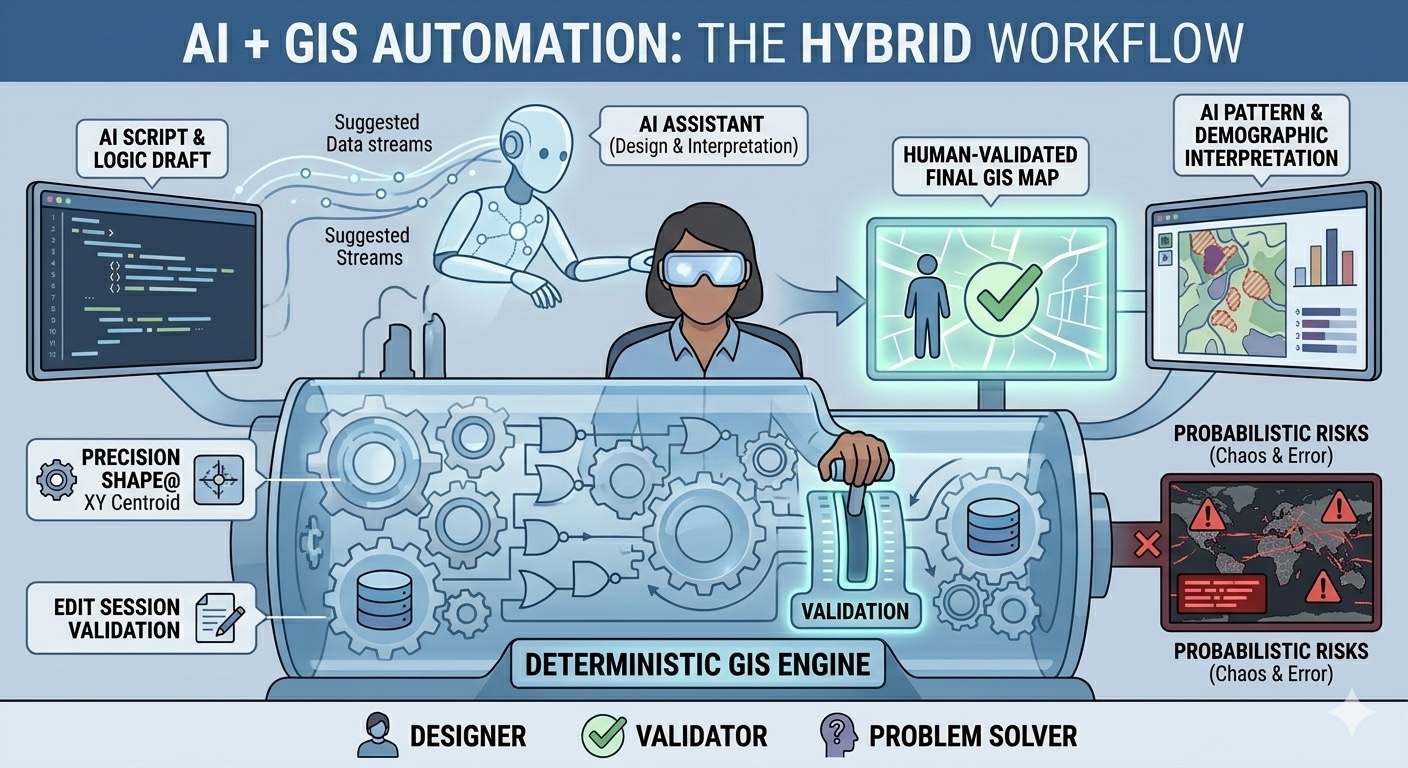
The first is workflow design and code generation, before anything runs in production. AI is a strong collaborator for drafting an ArcPy script, explaining which geoprocessing tools apply to a problem, converting a manual workflow into pseudocode, suggesting validation checks, or refactoring a script into reusable functions. The output is reviewed, tested, and committed by a person. The deterministic execution comes later.
The second is interpretation and communication, after the deterministic workflow has produced its results. AI is useful for summarizing spatial patterns in plain language for a council briefing, drafting first-pass metadata, translating a technical analysis for a public dashboard, or generating documentation that an analyst would otherwise put off until a deadline. The underlying analysis stays deterministic. The AI helps turn the result into something different audiences can act on.
The third is GeoAI: machine learning models for tasks like building footprint extraction, land cover classification, or object detection from imagery. These models are inherently probabilistic, but the workflow around them does not have to be. Imagery dates, study areas, confidence thresholds, output schemas, review processes, and publication rules are all deterministic. The model produces candidates. The deterministic workflow turns those candidates into a reviewable, repeatable GIS product.
What these three roles have in common is that AI sits inside a deterministic frame, not in place of it.
A worked example: parcel validation before publication
Consider a familiar government workflow — validating a parcel feature class before it is published to the public viewer or handed to the assessor’s office.
The deterministic core is straightforward, and the parts of it that matter to an auditor are exactly the parts that need to stay deterministic. A validation script checks for null parcel IDs. It validates geometry and flags self-intersections. It identifies overlaps between adjacent parcels and gaps where coverage should be continuous. It compares stated acreage against geometry-derived acreage and flags discrepancies above a threshold. It confirms that required fields are populated and that values fall within allowed domains. It writes an error layer with one record per issue, scoped to the parcels that need attention. Every check is explicit. Every threshold is documented. The script can be rerun, version-controlled, and handed to a successor.
AI fits around this in three places, none of them inside the validation logic itself.
Before the script is written, an analyst can use AI to draft the initial ArcPy code, suggest checks the team might have forgotten, or generate test cases against a sample geodatabase. The team reviews the suggestions, adjusts them to match local conventions, and commits the final script.
After the script runs, AI can summarize recurring error patterns across a quarter of validation runs, draft a QA report for a supervisor, or translate the technical error layer into language an assessor’s office staff member can act on. The error layer itself is unchanged.
Outside the validation entirely, AI can help maintain the documentation that makes the workflow defensible — keeping the README current, generating release notes when the schema changes, drafting metadata for the published feature class.
What is conspicuously absent from this list is AI making validation decisions. “Does this parcel have a problem?” is not a question to delegate to a probabilistic model. The rules are explicit, the consequences of error are public, and the value of the workflow is precisely that it produces the same answer every time given the same data.
The practitioner’s new role
The practitioner who can do this work — design the deterministic core, identify where AI accelerates the surrounding tasks, and tell the difference between a plausible AI output and a spatially valid one — is more valuable now than they were before AI got good. Not less.
A GIS analyst who understands ArcPy, projections, geoprocessing environments, schema design, spatial joins, and quality control can use AI productively because they know when it is wrong. They know that a buffer distance has to be in projected units, not degrees. They know a spatial join can produce duplicates if the join_operation parameter isn’t set correctly. They know a dissolve loses attributes without a properly configured statistics field. They know that 2010 census tracts and 2020 census tracts are different geometries and not directly comparable without a crosswalk.
These are not advanced concepts. They are the basics of working GIS. But they are exactly the basics an AI does not reliably know about your data, and exactly the basics that determine whether the AI’s output is useful or dangerous.
The job is not “operate the AI.” The job is the same job it has always been — design defensible spatial workflows for the agency — with a faster way to draft, document, and explain along the way.
What this means going forward
AI is going to keep getting better at the things it is already good at: generating plausible code, summarizing results, drafting language, finding patterns in unstructured data. None of that changes the underlying requirement of government GIS work, which is that the analysis behind a public decision has to be repeatable, reviewable, and defensible.
The future of GIS automation is not AI replacing deterministic workflows. It is AI making deterministic workflows easier to build, document, and explain — while the workflows themselves stay rule-based, version-controlled, and reproducible.
The determinism gap is the space between what an AI can produce and what your job actually requires. The practitioners who close that gap are the ones whose work ships, holds up under review, and survives the next staff turnover.
